

Hey there! As a supplier of PET honeycomb panels, I often get asked about various technical aspects of these products. One question that pops up quite frequently is, "What is the Poisson's ratio of a PET honeycomb panel?" Well, let's dive right into it and break down this concept.
First off, let's talk a bit about what Poisson's ratio actually means. In simple terms, Poisson's ratio is a measure of how a material responds to stress in different directions. When you apply a force to a material in one direction, it not only deforms in that direction but also in the perpendicular directions. Poisson's ratio is the ratio of the transverse strain (deformation in the perpendicular direction) to the axial strain (deformation in the direction of the applied force).
Now, for a PET honeycomb panel, the Poisson's ratio can vary depending on a few factors. The structure of the honeycomb itself plays a big role. PET honeycomb panels are made up of a series of hexagonal cells, and this unique structure gives them some interesting mechanical properties.
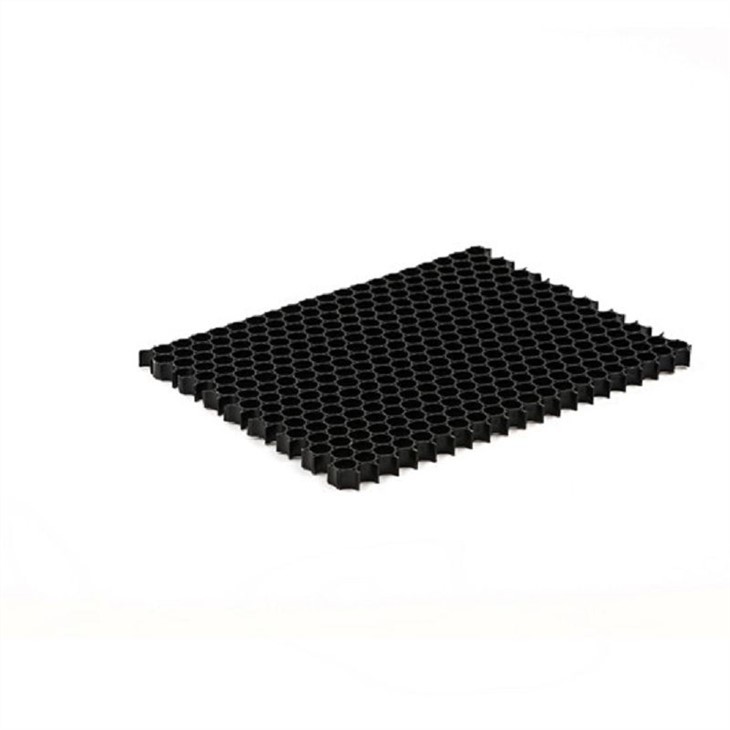
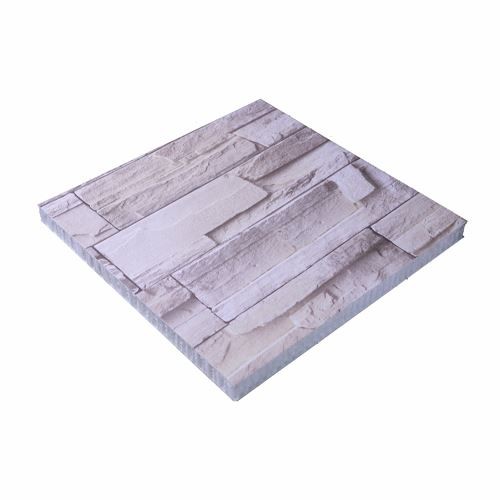
The Poisson's ratio of a PET honeycomb panel typically falls within a certain range. Generally, it can be anywhere from around 0.1 to 0.3. But why does it matter? Well, understanding the Poisson's ratio of a PET honeycomb panel is crucial for a number of applications.
In construction, for example, it helps engineers design structures that can withstand different types of loads. If you're using PET honeycomb panels in Honeycomb-building-panels for a building facade, knowing the Poisson's ratio allows you to predict how the panels will deform under wind pressure or other external forces. This ensures that the panels will maintain their integrity and functionality over time.
In the automotive industry, PET honeycomb panels are often used for lightweighting purposes. The Poisson's ratio affects how the panels respond to vibrations and impacts. By optimizing the Poisson's ratio, manufacturers can create parts that are both strong and lightweight, improving fuel efficiency and overall performance.
Another important factor that influences the Poisson's ratio of a PET honeycomb panel is the material properties of the PET itself. PET, or polyethylene terephthalate, is a thermoplastic polymer. Its molecular structure and the way it's processed can affect how the material deforms under stress.
The manufacturing process of the honeycomb panel also has an impact. Factors such as the cell size, wall thickness, and density of the honeycomb can all change the Poisson's ratio. For instance, a panel with smaller cell sizes might have a different Poisson's ratio compared to one with larger cells.
Now, let's take a closer look at how the Poisson's ratio is measured. There are a few different methods, but one common way is through a tensile test. In a tensile test, a sample of the PET honeycomb panel is pulled in one direction while the deformation in the perpendicular directions is measured. The ratio of these deformations gives you the Poisson's ratio.
It's important to note that the Poisson's ratio can also change depending on the loading conditions. For example, if the panel is subjected to a static load (a constant force over time), the Poisson's ratio might be different compared to when it's subjected to a dynamic load (a force that changes over time).
As a supplier of PET honeycomb panels, I work closely with our customers to ensure they have all the information they need about the Poisson's ratio and other mechanical properties of our products. We conduct extensive testing to provide accurate data and help our customers make informed decisions.
Our Thermoplastic Honeycomb Core is designed to have optimal Poisson's ratio values for a wide range of applications. Whether you're in the aerospace, marine, or packaging industry, our panels can offer the performance you need.
If you're in the market for high-quality PET honeycomb panels and want to learn more about the Poisson's ratio and how it can benefit your project, don't hesitate to reach out. We're here to help you find the perfect solution for your specific requirements. Whether you have a small-scale project or a large industrial application, we have the expertise and products to meet your needs.
In conclusion, the Poisson's ratio of a PET honeycomb panel is an important property that affects its performance in various applications. By understanding this concept and working with a reliable supplier, you can ensure that your projects are successful and your products meet the highest standards. So, if you're interested in purchasing PET honeycomb panels, get in touch with us today and let's start a conversation about how we can help you.
References
- Smith, J. (2020). Mechanics of Composite Materials. Wiley.
- Jones, A. (2019). Honeycomb Structures: Design, Manufacturing, and Applications. Elsevier.